Lignans are a large and diverse subgroup of non-flavonoid polyphenols.[1][2]
Their basic chemical structure consists of diphenylpropane dimers linked by a covalent carbon-carbon bond. Like other polyphenols, lignans are also derived from the secondary metabolism of plants, specifically via the shikimic acid pathway.[3][4]
They are widely distributed throughout the plant kingdom, in various organs and tissues, where they perform defensive functions.[5][6]
Lignans are found in various fruits, vegetables and whole grains in relatively low concentrations, while they are present in significantly higher concentrations in sesame and linseed. They are also present in drinks such as wine, tea and coffee.[7][8]
Once ingested, lignans undergo digestive processes and, particularly in the colon through the action of the gut microbiota, undergo chemical modifications that increase their bioavailability, facilitating their subsequent absorption.[9]
Lignans are bioactive organic molecules capable of exerting positive effects in the prevention of lifestyle-related diseases, such as type 2 diabetes, cardiovascular disease and cancer.[10][11][12]
Summary: Key Points
- Definition and chemical structure: lignans are non-flavonoid polyphenols derived from phenylpropanoids, consisting of dimers linked by a carbon-carbon bond. They are classified into lignans, neolignans, and norlignans.
- Biosynthesis and stereoselectivity: the synthesis involves conversion into monolignols followed by dimerisation, stereoselectively guided.
- Ecological function: in plants, they act as defensive metabolites against biotic and abiotic stresses.
- Dietary sources: they are widely distributed in the plant kingdom but found in highest concentrations in flaxseeds and sesame seeds and their respective oils.
- Metabolism and microbiota: resistant to gastric and partially to small intestinal digestion, they are transformed in the colon by the gut microbiota into bioactive enterolignans with enhanced bioavailability.
- Health effects: in vitro, animal, and epidemiological studies highlight the potential adjuvant role of lignans in preventing chronic-degenerative diseases.
Contents
- Chemical structure
- Biosynthesis
- Functions in plants
- Food sources
- Lignans and gut microbiota
- Lignans and human health
- References
Chemical structure
The basic chemical structure of lignans, which are secondary plant metabolites, consists of two phenylpropane units: an aromatic ring to which a three-carbon chain is attached, linked via a carbon–carbon bond that is formed primarily between the central atoms of the respective side chains (position 8 or β); this bond is also known as a β-β’ bond. These compounds are also referred to as ‘classical lignans’.
Less commonly, 3-3’, 8-O-4’ or 8-3’ bonds are observed; in these cases, the dimers are termed neolignans, molecules that exhibit more varied structures than classical lignans.
A third class is represented by norlignans, which are lignans lacking one or more carbon atoms.[2]
Their chemical structure can therefore be denoted as (C6–C3)2 and, like the hydroxycinnamic acids from which they are derived, they belong to the class of phenylpropanoids.
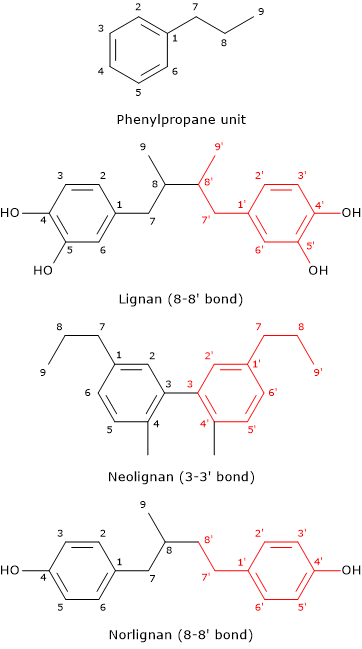
Note: In the early 1940s, R.D. Haworth coined the term ‘lignan’ specifically to describe the structure of a dimeric phenylpropanoid formed by two C6–C3 units linked together at the C8 position.[13]
Based on their carbon skeleton, their cyclisation pattern, usually in the form of dimers, though some also occur as trimers or tetramers, and the way in which oxygen is incorporated into the molecular skeleton, they are divided into eight subgroups: furanes, furofuranes, dibenzylbutanes, dibenzylbutyrolactones, dibenzocyclooctadienes, dibenzylbutyrolactols, aryltetralins and arylnaphthalenes. In addition, there is considerable variability regarding the levels of oxidation of the propyl side chains and of both aromatic rings.[5]
In nature, many occur in free form, although some may be bound to other molecules, typically glycosylated forms, but also other derivatives.[14]
Biosynthesis
Lignans are one of the products of secondary plant metabolism, that is, those metabolic pathways that lead to the synthesis of organic molecules which are not essential for growth, reproduction and development, such as carbohydrates, proteins and nucleic acids, but which are fundamental for interaction with the surrounding environment, and therefore for survival.[3]
Specifically, these phytochemicals are derived from the shikimic acid pathway, following conversion through successive steps, and thus from chorismate to trans-cinnamic acid via the deamination of phenylalanine in the reaction catalysed by phenylalanine ammonia-lyase (EC 4.3.1.24). This is followed by the production of the hydroxycinnamic acids: p-coumaric, caffeic, ferulic and sinapic acids. With the exception of caffeic acid, the others serve as starting points for the synthesis of some of the most common lignans.[6][15]
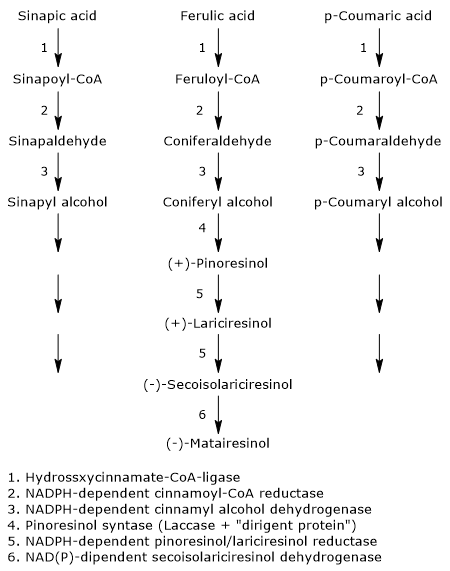
The first three reactions reduce the carboxyl groups of hydroxycinnamates to alcohol groups, resulting in the formation of monolignols, namely p-coumaryl alcohol, sinapyl alcohol and coniferyl alcohol, molecules that also play a part in the biosynthesis of lignin.
- The first reaction leads to the activation of hydroxycinnamic acids and is catalysed by hydroxycinnamate:CoA ligase or 4-coumarate:CoA ligase (EC 6.2.1.12), resulting in the formation of the corresponding hydroxycinnamate-CoA, namely feruloyl-CoA, p-coumaryl-CoA and sinapyl-CoA.
- Next, NADPH-dependent cinnamoyl-CoA oxidoreductases or cinnamoyl-CoA reductases (EC 1.2.1.44) catalyse the formation of the corresponding aldehyde, with the release of coenzyme A.
- In the final reaction, NADPH-dependent cinnamyl alcohol dehydrogenases or monolignol dehydrogenases (EC 1.1.1.195) reduce the aldehyde group to an alcohol, forming coniferyl alcohol, p-coumaryl alcohol and sinapyl alcohol.[5]
Dimerisation
The next step, dimerisation, involves stereoselective mechanisms, or more precisely, enantioselective mechanisms. In fact, most plant lignans exist as (+)- or (–)-enantiomers, i.e. isomers possessing at least one centre of chirality, the relative proportions of which may vary from species to species, but also within different organs of the same plant, depending on the type of reactions involved.[16]
Dimerisation can be achieved through reactions catalysed by laccases (EC 1.10.3.2), enzymes that catalyse the formation of radicals which, upon dimerisation, create a racemic mixture. The most widely accepted mechanism for explaining stereoselective synthesis involves the action of laccases and a protein capable of directing the synthesis towards one or the other of the two enantiomeric forms: the dirigent protein. The reaction scheme could be as follows: the enzyme forms the radicals, which are oriented by the directing protein so as to achieve the desired stereoselective pairing.[17]
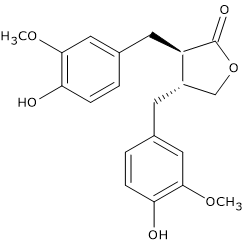
For example, pinoresinol synthase, comprising laccase and a chaperone protein, catalyses the stereoselective synthesis of (+)-pinoresinol from two coniferyl alcohol residues. Subsequently, (+)-pinoresinol, in two consecutive stereoselective reactions catalysed by NADPH-dependent pinoresinol/lariciresinol reductase (EC 1.23.1.1), is first reduced to (+)-lariciresinol and then to (–)-secoisolariciresinol. (–)-Secoisolariciresinol is then oxidised to (–)-matairesinol in a reaction catalysed by NAD(P)-dependent secoisolariciresinol dehydrogenase (EC 1.1.1.331).[5]
Functions in plants
Lignans, like other polyphenols, perform important functions in plants, albeit manifested through diverse biological activities depending on time and context.[6] Found in various parts of plants, such as seeds, rhizomes, roots, resins, leaves and fruits, they essentially serve a defensive function in response to injury, fungal and bacterial attacks, and abiotic stresses such as extreme temperatures, drought, salinity, heavy metals and UV radiation.[18][19]
Food sources
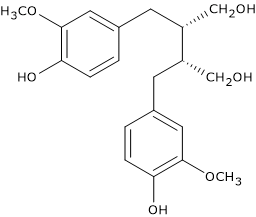
Lignans are widely found in plant-based foods, although in very varying quantities, with the main sources being certain oilseeds and their oils. They are also present in trace amounts in beverages such as wine, tea and coffee. Among the most abundant are lariciresinol, matairesinol, pinoresinol and secoisolariciresinol, followed by medioresinol, syringaresinol and sesamin.[20]
Oilseeds
Among oilseeds and the oils derived from them, the richest in lignans are linseeds (Linum usitatissimum), sesame seeds (Sesamum indicum) and cashew nuts (Anacardium occidentale).
Sesame and linseed are by far the richest sources, with concentrations of ≈ 285 mg/100 g and 775 mg/100 g respectively. Higher concentrations are found in the corresponding oils, with sesame oil reaching ≈ 1250 mg/100 g of product; by comparison, extra virgin olive oil, the cornerstone of the Mediterranean diet, contains ≈ 1 mg/100 g, while sunflower oil contains approximately 1.5 mg/100 g.[21]
Cereals
In cereals, they are concentrated to a greater extent in the outer layers of the grain and are much less abundant in the endosperm. It follows that whole grains are richer in lignans than refined ones.
Among the richest sources are rye (Secale cereale), wheat (Triticum aestivum), oats (Avena sativa L.) and triticale (×Triticosecale).[8]
Vegetables and fruits
Among vegetables, the richest sources, which also exhibit significant internal variability, are the cruciferous vegetables (Brassicaceae family), whose nutritional profile is characterised in particular by high concentrations of lariciresinol. Broccoli, kale, Brussels sprouts, white/red cabbage and sauerkraut, and cauliflower contain ≈ 95 mg/100 g, 60 mg/100 g, 50 mg/100 g, 20 mg/100 g and 9.5 mg/100 g respectively.
Other vegetables have a significantly lower lignan content, even below 0.1 mg/100 g.[21]
Fruits have a lower lignan content than vegetables, ranging from ≈ 11 mg/100 g for apricots down to zero for bananas.[7]
Drinks
In drinks, both alcoholic ones such as wine and beer, and non-alcoholic ones such as green tea, coffee or black tea, lignans are often present, although in concentrations well below 0.1 mg/100 g.[22]
| Food source | Main represented lignans | Approximate average concentration | Food class | Biochemical and nutritional notes |
|---|---|---|---|---|
| Flaxseeds (Linum usitatissimum) | Secoisolariciresinol, lariciresinol | ≈ 775 mg / 100 g | Oilseeds | The absolute richest plant source; high content of enterolignan precursors. |
| Sesame seeds (Sesamum indicum) | Sesamin, sesamolin, pinoresinol | ≈ 285 mg / 100 g | Oilseeds | Exceptionally high content; maximum concentrations detected in derived oils (≈ 1250 mg / 100 g). |
| Whole grains | Lariciresinol, pinoresinol, secoisolariciresinol | Variable (concentrated in outer layers) | Cereals and derivatives | Present in greater amounts in the outer bran layers of the grain; drastically reduced in refined products. |
| Cruciferous vegetables | Lariciresinol, pinoresinol | From ≈ 9.5 to ≈ 95 mg / 100 g | Vegetables (Brassicaceae) | Represent the primary source among vegetables, with profiles dominated by high concentrations of lariciresinol. |
Lignans and gut microbiota
Phytochemicals ingested through the diet, namely carotenoids, polyphenols and glucosinolates, are, like most other molecules present in food, subject to the action of digestive processes, such as gastric acids and enzymes, which promote their release or modification to facilitate their subsequent absorption in the intestine.[23]
The digestive process affecting lignans and their glycosides does not appear to involve the gastric phase, during which they undergo negligible changes.[9][24]
A modest degree of deglycosylation may occur in the small intestine, mediated by enzymes in the brush border. However, the most significant chemical modifications take place in the colon, mediated by the gut microbiota, the intestinal ‘component’ of the broader human microbiota. Through the action of bacterial enzymes, lignans and their glycosides are metabolised, via deglycosylation, demethylation, dehydroxylation and dehydrogenation, into enterolignans or mammalian lignans, namely enterodiols and enterolactones. These are molecules with a chemical structure similar to that of oestrogens, with greater bioavailability than their precursors and modest oestrogenic activity, similar to isoflavones.[4][20][25][26]
Enterodiols and enterolactones are therefore absorbed by colonocytes and conjugated with glucuronic acid or sulphates, before entering the enterohepatic circulation, with peak levels appearing after 12–24 hours for enterodiols and 24–36 hours for enterolactones. Enterolignans are excreted in the urine as monoglucuronides, and to a lesser extent as diglucuronides and sulphates; free enterolignans are excreted in the faeces.[27]
Lignans and human health
The health benefits associated with the consumption of plant-based foods are, at least in part, due to the presence of phytochemicals.
In vitro and animal studies have shown that lignans possess various biological activities, such as anti-inflammatory, antioxidant, anti-tumour, antibacterial and antiviral effects, as well as oestrogenic agonist and antagonist properties.[9][10][14][28]
Some epidemiological studies have shown that, amongst polyphenols, a diet rich in lignans is associated with a reduced risk of developing numerous chronic diseases, such as type 2 diabetes, various types of cancer and cardiovascular diseases.[21]
Although definitive proof is lacking, it nevertheless seems reasonable to state that a diet rich in lignans helps to reduce the likelihood of developing numerous chronic degenerative diseases.
References
- ^ Andersen Ø.M., Markham K.R. Flavonoids: chemistry, biochemistry, and applications. 1st Edition. CRC Press Taylor & Francis Group, 2006. doi:10.1201/9781420039443.
- a b Berenshtein L., Okun Z., Shpigelman A. Stability and bioaccessibility of lignans in food products. ACS Omega 2024;9(2):2022-2031. doi:10.1021/acsomega.3c07636
- a b Wink M. Biochemistry of plant secondary metabolism – 2nd Edition. Annual plant reviews (v. 40), Wiley J. & Sons, Inc., Publication, 2010.
- a b Satake H., Koyama T., Bahabadi S.E., Matsumoto E., Ono E., Murata J. Essences in metabolic engineering of lignan biosynthesis. Metabolites 2015;5(2):270-90. doi:10.3390/metabo5020270.
- a b c d Heldt H-W., Heldt, F. Plant biochemistry. 3th Edition. Elsevier Academic Press, 2005.
- a b c Ražná K., Nôžková J., Vargaová A., Harenčár Ľ., Bjelková M. Biological functions of lignans in plants. Agriculture (Poľnohospodárstvo) 2021;67(4):155-165. doi:10.2478/agri-2021-0014
- a b Landete J.M. Plant and mammalian lignans: a review of source, intake, metabolism, intestinal bacteria and health. Food Res Int 2012;46(1) pag. 410-424. doi:10.1016/j.foodres.2011.12.023
- a b Durazzo A., Zaccaria M., Polito A., Maiani G., Carcea M. Lignan content in cereals, buckwheat and derived foods. Foods 2013;2(1):53-63. doi:10.3390/foods2010053
- a b c Baldi S., Tristán Asensi M., Pallecchi M., Sofi F., Bartolucci G., Amedei A. Interplay between lignans and gut microbiota: nutritional, functional and methodological aspects. Molecules 2023;28(1):343. doi:10.3390/molecules28010343
- ^ Peterson J., Dwyer J., Adlercreutz H., Scalbert A., Jacques P., McCullough M.L. Dietary lignans: physiology and potential for cardiovascular disease risk reduction. Nutr Rev 2010;68(10):571-603. doi:10.1111/j.1753-4887.2010.00319.x
- ^ Parikh M., Maddaford T.G., Austria J.A., Aliani M., Netticadan T., Pierce G.N. Dietary flaxseed as a strategy for improving human health. Nutrients 2019;11(5):1171. doi:10.3390/nu11051171
- ^ Jang W.Y., Kim M.Y., Cho J.Y. Antioxidant, anti-Inflammatory, anti-menopausal, and anti-cancer effects of lignans and their metabolites. Int J Mol Sci 2022;23(24):15482. doi:10.3390/ijms232415482
- ^ Haworth R. D. The chemistry of the lignan group of natural
products. Journal of the Chemical Society (Resumed) 1942;21:448−56. - a b Cui Q., Du R., Liu M., Rong L. Lignans and their derivatives from plants as antivirals. Molecules 2020;25(1):183. doi:10.3390/molecules25010183
- ^ Teponno R.B., Kusari S., Spiteller M. Recent advances in research on lignans and neolignans. Nat Prod Rep 2016;33(9):1044-92. doi:10.1039/c6np00021e
- ^ Touré A., Xueming X. Flaxseed lignans: source, biosynthesis, metabolism, antioxidant activity, bio-active components, and health benefits. Compr Rev Food Sci Food Saf 2010;9(3):261-269. doi:10.1111/j.1541-4337.2009.00105.x
- ^ Davin L.B., Lewis N.G. An historical perspective on lignan biosynthesis: monolignol, allylphenol and hydroxycinnamic acid coupling and downstream metabolism. Phytochem Rev 2003;2:257-288. doi:10.1023/B:PHYT.0000046175.83729.b5
- ^ Garros L., Drouet S., Corbin C., Decourtil C., Fidel T., Lebas de Lacour J., Leclerc E.A., Renouard S., Tungmunnithum D., Doussot J., Abassi B.H., Maunit B., Lainé É., Fliniaux O., Mesnard F., Hano C. Insight into the influence of cultivar type, cultivation year, and site on the lignans and related phenolic profiles, and the health-promoting antioxidant potential of flax (Linum usitatissimum L.) seeds. Molecules 2018;23(10):2636. doi:10.3390/molecules23102636
- ^ Ghotbzadeh Kermani S., Saeidi G., Sabzalian M.R., Gianinetti A. Drought stress influenced sesamin and sesamolin content and polyphenolic components in sesame (Sesamum indicum L.) populations with contrasting seed coat colors. Food Chem 2019;289:360-368. doi:10.1016/j.foodchem.2019.03.004
- a b Senizza A., Rocchetti G., Mosele J.I., Patrone V., Callegari M.L., Morelli L., Lucini L. Lignans and gut microbiota: an interplay revealing potential health implications. Molecules 2020;25(23):5709. doi:10.3390/molecules25235709
- a b c Rodríguez-García C., Sánchez-Quesada C., Toledo E., Delgado-Rodríguez M., Gaforio J.J. Naturally lignan-rich foods: a dietary tool for health promotion? Molecules 2019;24(5):917. doi:10.3390/molecules24050917
- ^ Milder I.E., Arts I.C., van de Putte B., Venema D.P., Hollman P.C. Lignan contents of Dutch plant foods: a database including lariciresinol, pinoresinol, secoisolariciresinol and matairesinol. Br J Nutr 2005;93(3):393-402. doi:10.1079/bjn20051371
- ^ Guyton A.C., Hall J.E. Textbook of medical physiology. 14th Edition. Philadelphia: Elsevier, 2021.
- ^ Fuentealba C., Figuerola F., Estévez A.M., Bastías J.M., Muñoz O. Bioaccessibility of lignans from flaxseed (Linum usitatissimum L.) determined by single-batch in vitro simulation of the digestive process. J Sci Food Agric 2014;94(9):1729-38. doi:10.1002/jsfa.6482
- ^ Fardet A. New hypotheses for the health-protective mechanisms of whole-grain cereals: what is beyond fibre? Nutr Res Rev 2010;23(1):65-134. doi:10.1017/S0954422410000041
- ^ Seyed Hameed A.S., Rawat P.S., Meng X., Liu W. Biotransformation of dietary phytoestrogens by gut microbes: a review on bidirectional interaction between phytoestrogen metabolism and gut microbiota. Biotechnol Adv 2020;43:107576. doi:10.1016/j.biotechadv.2020.107576
- ^ Setchell K.D., Brown N.M., Zimmer-Nechemias L., Wolfe B., Jha P., Heubi J.E. Metabolism of secoisolariciresinol-diglycoside the dietary precursor to the intestinally derived lignan enterolactone in humans. Food Funct 2014;5(3):491-501. doi:10.1039/c3fo60402k
- ^ Álvarez-Martínez F.J., Barrajón-Catalán E., Encinar J.A., Rodríguez-Díaz J.C., Micol V. Antimicrobial capacity of plant polyphenols against Gram-positive bacteria: a comprehensive review. Curr Med Chem. 2020;27(15):2576-2606. doi:10.2174/0929867325666181008115650
Domande Frequenti
What exactly are lignans and where can they be found?
Lignans are polyphenolic phytochemicals found in oilseeds, whole grains, vegetables, and fruits. They serve defensive roles in plants and act as powerful bioactive precursors beneficial to human health after gut transformation.
What are the primary and richest dietary sources available?
Flaxseeds and sesame seeds are by far the richest dietary sources, with concentrations exceeding 700 mg/100 grams. They are followed by whole grains, cruciferous vegetables, and smaller amounts in fruits and beverages.
How does the gut microbiota metabolize and process lignans?
In the colon, intestinal bacteria metabolize plant lignans via deglycosylation and demethylation, converting them into enterolignans (enterodiol and enterolactone), molecules featuring higher bioavailability and systemic biological activity.